Check Engine Light Flashing: Stop Driving & What It Costs to Fix
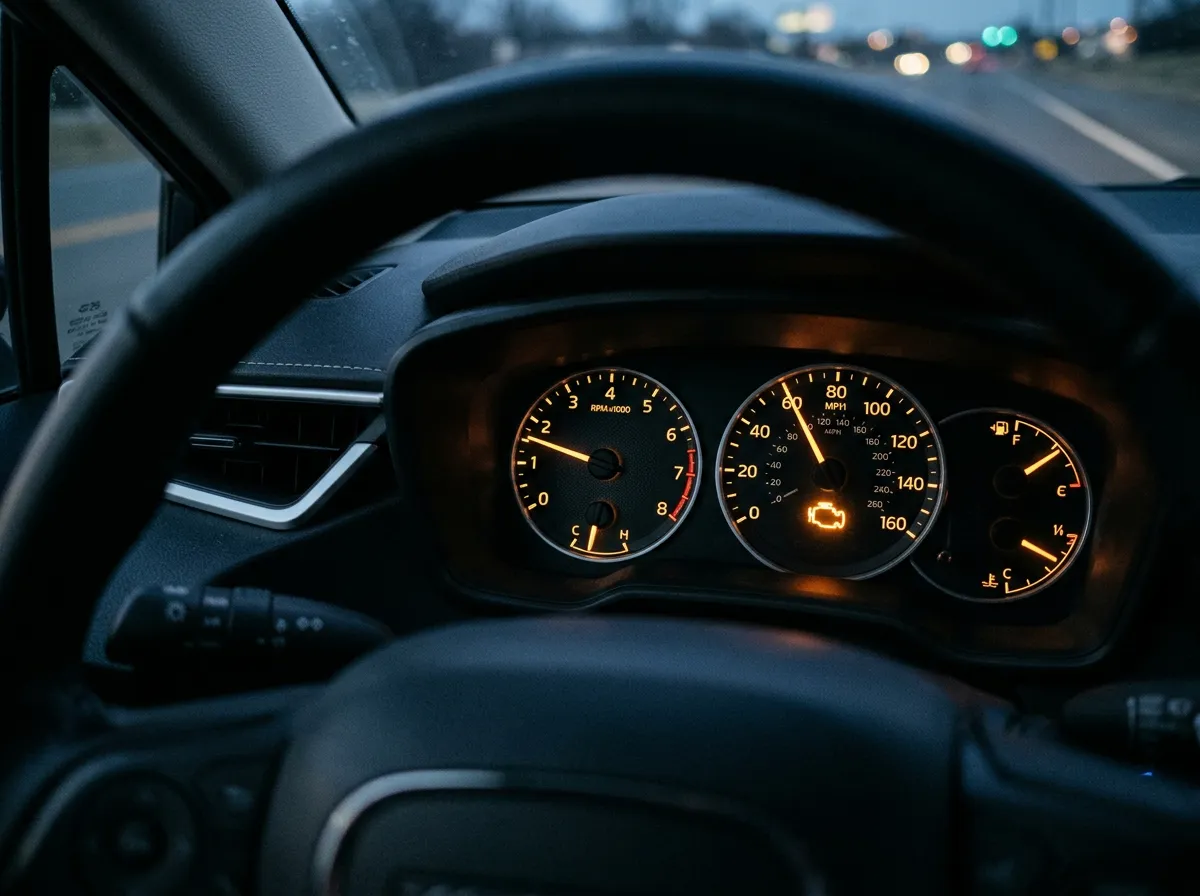
Unlike a steady Check Engine Light, a flashing (blinking) light means raw unburned fuel is dumping directly into your hot exhaust. Driving even 5–10 miles can melt a $1,200–$2,500 catalytic converter and turn a $200 ignition coil fix into a $2,500 bill.
A flashing Check Engine Light almost always indicates a severe active engine misfire (OBD2 codes P0300–P0306). Most fixes are modest if you stop immediately—an ignition coil and spark plugs run $180–$480 at an independent shop. Continuing to drive overheats the catalytic converter ($1,200–$2,500+) and risks fire.
Most Likely Causes & Typical U.S. Repair Costs
| Likely Cause | Frequency | Typical Cost (USD) | Clues & Safe-to-Drive Guidance |
|---|---|---|---|
| Failed Ignition Coil Pack (Most Common) | Most Common | $180–$360 (single coil) · $350–$650 (with plugs) | Sudden engine shaking at idle, sluggish acceleration, single-cylinder code (P0301–P0306). Can I drive? No — tow to shop to save the catalytic converter. |
| Worn or Oil-Fouled Spark Plugs | Most Common | $220–$480 (4-cyl or V6 set) | Rough idle under load; common on 2011–2017 Honda Odyssey VCM engines past 80k miles. Can I drive? No — active misfire still dumps fuel into exhaust. |
| Stuck or Clogged Fuel Injector | Common | $420–$1,250 (higher on direct-injection 1.5T engines) | Strong fuel smell, multiple warning lights (seen on 2017–2021 Honda CR-V 1.5T). Can I drive? No — stuck-open injector can also cause engine hydro-lock or oil dilution. |
| Jumped Timing Belt or Severe Mechanical Compression Loss | Less Common | $950–$1,600 (belt if no valve damage) · $3,500+ (bent valves) | Loud tapping/rattling, sudden loss of power on high-mileage timing belt V6s. Can I drive? No — shut off immediately and do not restart. |
What to Do Right Now
- Ease off the accelerator, signal right, and pull safely onto the shoulder or into a parking lot.
- Turn the engine off immediately—do not let it idle for 20 minutes while waiting for a tow.
- If you smell rotten eggs or see glowing heat beneath the car, exit the vehicle and stand well clear.
- Use roadside assistance or a flatbed tow ($85–$150)—far cheaper than replacing a melted catalytic converter.
- If you own a basic $25 OBD2 scanner, read the P030x code with the key ON / engine OFF before the shop diagnoses it.
What to Say at the Repair Shop
Use these exact questions at the service counter to prevent guesswork part replacements:
"The Check Engine Light started flashing, so I pulled over and had it towed immediately. Please pull the freeze-frame misfire codes and check ignition coil/plug swap before quoting fuel or catalytic parts."
"If only one ignition coil failed, can you quote replacing the failed coil plus spark plugs if due, rather than all coils unnecessarily?"
Safety Notice: This triage guide is for informational decision support and is not a substitute for an in-person mechanical inspection. Whenever braking performance, steering control, or engine temperature is compromised, stop driving safely and arrange a tow.
Frequently Asked Questions
Can I drive 5 miles home with a flashing check engine light?+
No. Driving even 5 miles with a severe misfire can superheat your catalytic converter above 1,600°F, melting its internal honeycomb. A $100 tow saves a $1,500+ exhaust repair.
What if the check engine light flashed for 10 seconds and then went solid?+
That means a misfire crossed the catalyst-damage threshold under acceleration and then eased off. Avoid highway speeds and steep hills, scan the code immediately, and get it diagnosed before it flashes continuously.